
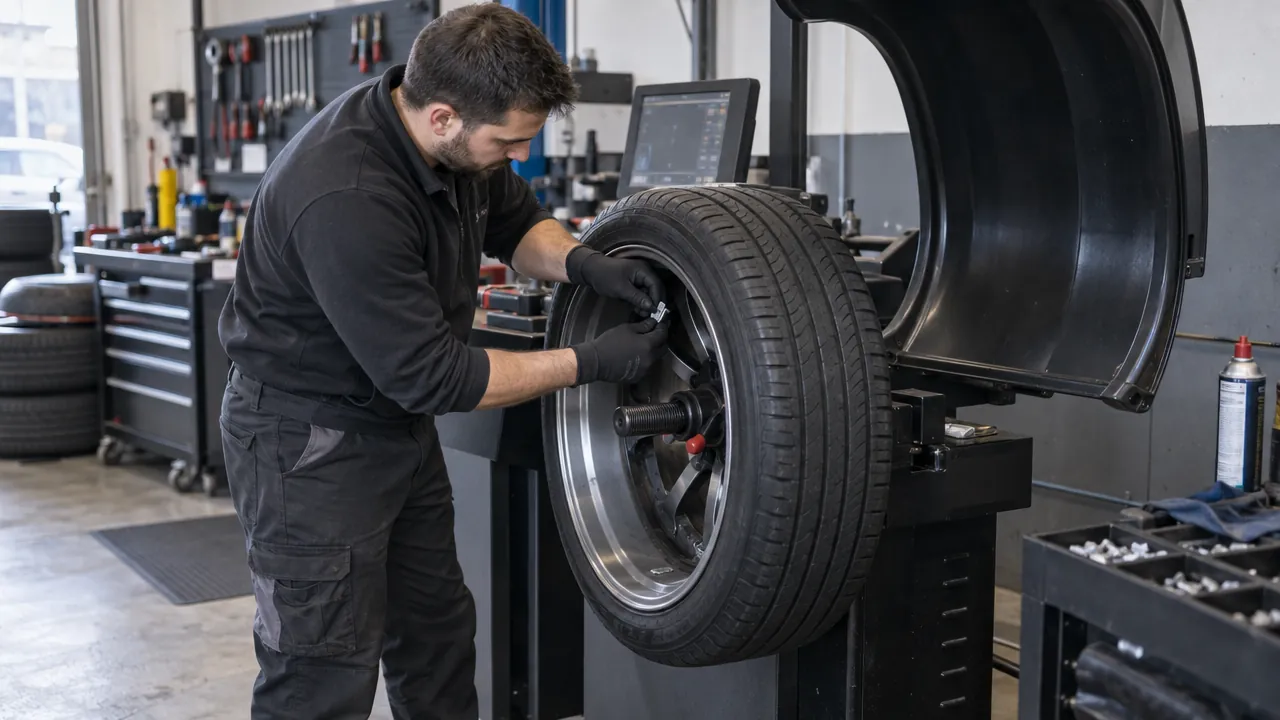
Wheel balancing corrects uneven weight around a wheel and tyre assembly. A technician removes the wheel, spins it on a balancing machine and attaches small weights to the rim where needed. A balanced assembly rotates more smoothly, helping the tyre maintain consistent road contact and wear more evenly across its width. Imbalance can make the ride uncomfortable and contribute to premature tyre wear, strain on suspension and wheel bearings, and poorer fuel economy. Tyre wear or handling problems left unchecked can also become a safety concern.
How long can you drive with unbalanced wheels?
There is no fixed time limit. If you notice signs of a possible imbalance, such as vibration while driving, arrange a check as soon as practical. Even without obvious symptoms, periodic checks are worthwhile. A wheel is balanced when a new tyre is fitted, but tread wears away during use, changing the assembly’s weight distribution. The source uses a tyre with around 8 mm of tread to illustrate that starting point; it is not a guaranteed depth for every new tyre.
Hitting a kerb or pothole can also shift a balancing weight. Continuing to drive with an imbalance may shorten tyre life and add stress to bearings and suspension, potentially costing more than a balance check. Vibration and uneven wear do not, however, prove that balance is the cause. Ask a garage to inspect the tyres and wheels rather than assuming that adding weights will resolve every symptom.
How much does wheel balancing cost?
The original UK source quoted £6.50 per wheel for balancing at its premises. That is an indicative figure from the source, not a current price or a rate that applies to other garages. At that quoted rate, four separately charged wheels would cost £26. The source also said balancing was included in its tyre-fitting charge when buying a tyre. When comparing costs, ask whether balancing is included in fitting or charged separately, and what the total will be for the work you need.
Do all four wheels need balancing?
The tyres are the car’s points of contact with the road, so the condition of all four matters. Checking all four wheels together, and balancing those that need it, can help maintain a smooth ride without overlooking another imbalance. The source recommends balancing all four for driving comfort and a potential fuel-economy benefit. That does not mean every wheel necessarily needs new weights at every check. If work concerns one tyre, ask which wheels require balancing.
When a tyre is removed from its wheel for puncture repair or replacement, have that assembly balanced before it goes back on the car. A replacement tyre changes the assembly’s weight distribution, so existing weights may no longer be suitable. Simply taking an intact wheel off the car is different from removing the tyre from its rim; ask the fitter whether a balance check is needed in that case.
How is alignment different from balancing?
Wheel alignment, also called tracking, concerns the angles and direction in which the wheels point. Wheels on an axle might toe in or toe out rather than point as intended. Correcting their angles helps the tyres meet the road properly. Balancing instead addresses uneven weight in each rotating wheel and tyre assembly. Both problems can contribute to premature tyre wear, poor fuel economy and an uncomfortable ride, but balancing will not correct alignment, and adjusting alignment will not redistribute a wheel’s weight.
Should balancing be done before alignment?
Balancing first is not mandatory before an alignment. For comfort and safety, though, check that the wheels are balanced and the tyres are in good condition. Set tyre pressures to the car’s recommended levels and make sure tread depth is above the UK legal limit. If wear is uneven, ask for its cause to be investigated rather than assuming either balancing or tracking alone will fix it.
If a tyre has been repaired or replaced, confirm whether the assembly was balanced during fitting. After a kerb or pothole strike, or if the car begins to vibrate, tell the garage when the change occurred so it can assess the tyres, wheels and alignment as appropriate.