
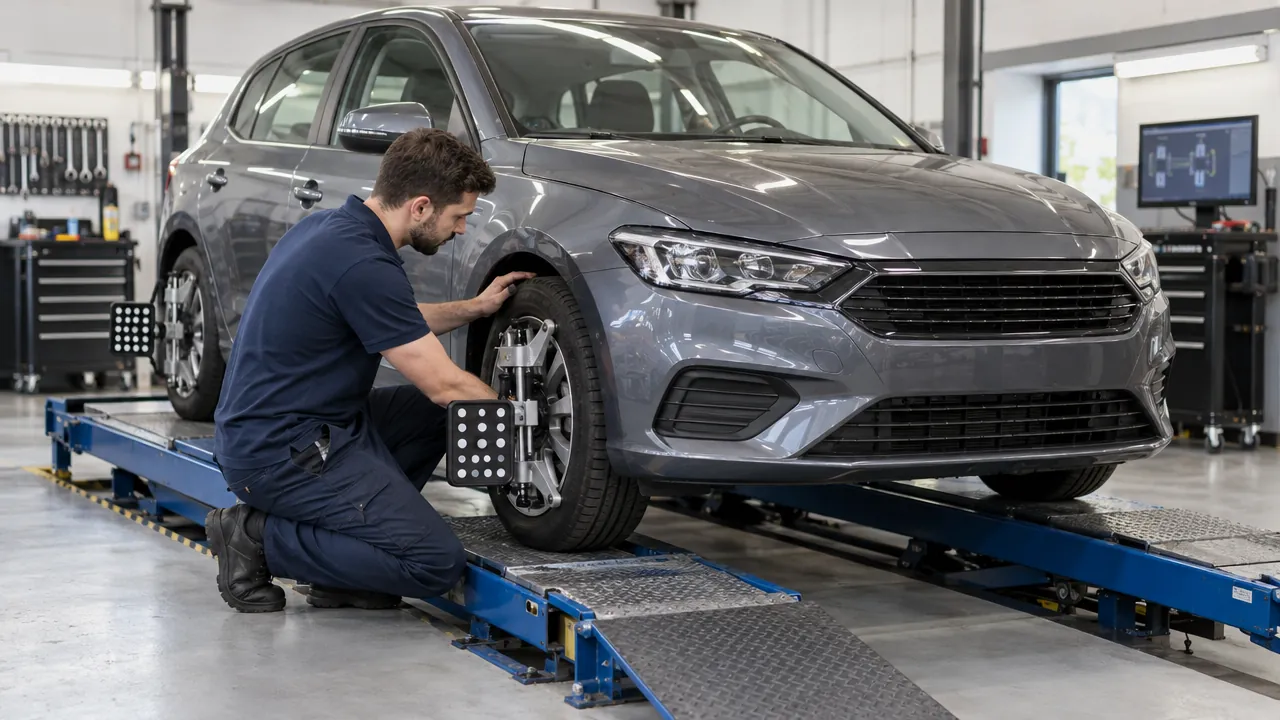
A car that wanders on the motorway or wears out its tyres unevenly may need its wheel alignment checked. Toe is often one of the first measurements worth examining: a small deviation can affect how the car tracks and how quickly its tyres wear. It is not, however, a diagnosis on its own. Tyre condition, suspension wear and other alignment angles can produce similar complaints. Understanding what toe means makes it easier to describe a problem to a workshop and to understand what an alignment report shows.
What is toe in wheel alignment?
Toe describes the direction wheels point when viewed from above. If the front edges of two wheels on the same axle point slightly towards each other, that is toe-in, or positive toe. If they point away from each other, that is toe-out, or negative toe. The measurement can be given for each wheel and as a total for the axle. Although the difference may amount to only a few millimetres, it can make a noticeable difference to steering feel and tyre scrub. The correct setting depends on the vehicle’s specifications.
Toe is one part of vehicle geometry, alongside measurements such as camber and caster. It matters on the rear axle as well as the front: rear wheels that do not track in the intended direction can influence the path the car follows. Complaints such as frequent steering corrections, an off-centre steering wheel or tyres wearing sooner than expected justify a check, but none proves that toe is the cause. A useful assessment looks at the car and its tyres before treating an alignment number as the whole problem.
How workshops measure toe
A basic string-line arrangement or laser gauge can indicate toe, but its accuracy depends heavily on careful positioning and setup. A small placement error can distort a reading when the adjustment itself is small. Many modern workshops use camera-based four-wheel alignment equipment instead. It measures individual wheels and displays live values, commonly in degrees and minutes. The technician can compare those readings with the vehicle manufacturer’s specifications rather than relying on a visual estimate or assuming that perfectly parallel wheels suit every car.
A four-wheel report can show individual and total toe, as well as the rear axle’s thrust angle: the direction in which that axle effectively points relative to the vehicle. This helps explain why simply adjusting the front wheels may not leave the steering wheel straight or the car tracking correctly. Measurements can also reveal a deviation that calls for inspection of worn or damaged suspension parts. The readings identify what needs investigating; they do not, by themselves, establish which component is at fault.
How toe is adjusted
Before making an adjustment, a workshop needs reliable measurements and should check for faults that would undermine the result, such as excessive play in steering or suspension components. On most vehicles, front toe is altered at the tie rods, also called track rods. Changing their effective length changes the direction of the front wheels. Small turns can change the reading appreciably, so the technician monitors both sides, works towards the specified values and checks the steering wheel position rather than setting one wheel in isolation.
Rear adjustment depends on the suspension. A multi-link axle may use eccentric bolts on its arms or subframe, while some trailing-arm arrangements use slotted mounts. A fixed-beam axle may need shims behind a hub to change toe in set increments; some designs have little or no routine adjustment. Performance or aftermarket arrangements may have adjustable rear arms. Where adjustment is available, the aim is to bring each wheel within specification and confirm that the axle tracks correctly. Live readings allow the technician to see changes while working and recheck the finished result.
How toe changes handling and tyre wear
Toe-in tends to favour straight-line stability: a driver may describe the car as more settled or less inclined to wander at motorway speeds. Too much toe-in, though, makes the tyres scrub as they roll, increasing rolling resistance and potentially harming fuel efficiency and tyre life. The original guide associates toe-in with wear towards the outer shoulders. That pattern is a clue rather than a definitive test, because tyre pressure, camber and other faults can affect which part of a tyre wears.
Toe-out can make the front end respond more readily when turning into a corner. Beyond the appropriate setting, that sharpness may become nervousness: the car can follow ruts, react to bumps or require repeated small corrections at speed. Toe-out can also heat tyres faster, which may be useful in motorsport but is generally undesirable for everyday driving. The guide associates excessive toe-out with inner-shoulder scrub. Again, the pattern should prompt inspection of the complete tyre and alignment, not an adjustment based on appearance alone.
Zero toe means the wheels on an axle point parallel when measured. It can offer a useful balance of even wear, fuel efficiency and straight-line comfort, but it is not a universal target. A manufacturer may specify some toe-in or toe-out for a particular vehicle. The practical goal is neither maximum stability nor the sharpest turn-in at any cost: it is the specified geometry with sound tyres and suspension. Otherwise, a change that makes steering feel different could merely trade one problem for premature tyre wear.
Toe, camber and caster work together
Toe concerns the direction a wheel points and influences steering response, stability and tyre scrub. Camber is the wheel’s tilt when viewed from the front: negative camber means its top leans inwards, while positive camber means it leans outwards. Camber can contribute to inner- or outer-shoulder wear and change how a vehicle grips in corners. If one side behaves differently from the other, looking only at toe risks missing part of the explanation.
Caster describes the steering-axis angle when viewed from the side. It affects steering weight, straight-line stability and how readily the steering self-centres. Lower caster can mean lighter steering with less stability; higher caster generally provides stronger self-centring but heavier steering. The angles are not independent in every adjustment, particularly where suspension is worn. A four-wheel check lets the workshop consider their combined effect and distinguish a setting outside specification from a mechanical fault that needs attention first.
Signs that an alignment check may help
Pulling or drifting to one side, especially when the driver repeatedly has to correct course on a dual carriageway or motorway, is a reason to investigate. So is steering that feels twitchy, floaty or unusually responsive to bumps and road ruts. Toe may contribute, but those descriptions do not identify it conclusively. Ask the workshop to consider tyre condition and the broader steering and suspension system as well as the alignment readings, rather than requesting a toe adjustment without a check.
Look at the tyres, too. One shoulder wearing rapidly while much of the tread still looks sound, or tyres needing replacement unexpectedly early, can indicate alignment trouble. Uneven wear should be assessed promptly because an adjustment cannot restore tread already lost. An off-centre steering wheel while driving straight is another clue: front toe settings or the relationship between the front wheels and rear thrust line may need attention. Tell the technician when the symptom appeared, particularly if it followed a tyre change, repair or kerb strike.
A vibration deserves a separate description. A vibration that appears mainly at a particular speed commonly points towards wheel balance, whereas one associated with changes in steering or handling may warrant an alignment check. Neither rule is certain: a balance check that found nothing does not prove toe is wrong. Describe when the vibration occurs and whether the car also pulls, wanders or shows uneven wear. That gives the workshop a better starting point than treating every unpleasant sensation at the steering wheel as an alignment fault.
When should toe be checked?
The source suggests checking toe roughly every 12,000–15,000 miles, whenever new tyres are fitted, and after steering or suspension work. A check is also sensible after a significant pothole or kerb impact, or sooner if the car begins to pull, wander or wear its tyres unevenly. These are suggested opportunities to check, not a guarantee that adjustment will be needed each time. An MOT advisory concerning tyres or suspension can also be a prompt to investigate the underlying condition.
Toe can change after an impact, as components wear or following repairs; everyday use may reveal a problem that was not previously obvious. If a workshop finds a worn bush, joint or other fault, correcting the number on the alignment screen alone may not give a lasting result. Have the fault assessed, then confirm the geometry against the vehicle’s specifications after the necessary work. Early investigation can help limit further tyre wear and make the car feel more predictable, without assuming toe is responsible for every steering complaint.